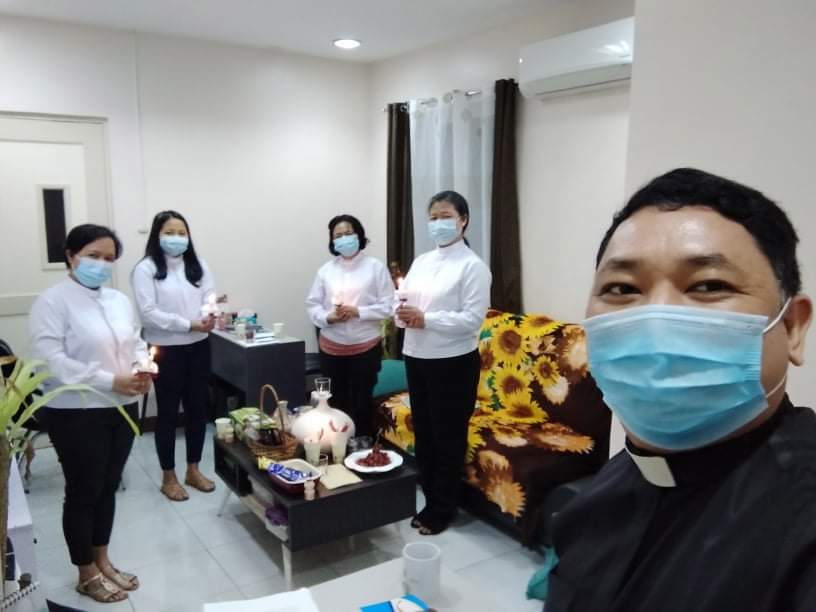
Things have been slow due to the pandemic… but several including Jethro, Hesed, and Bukal have been active with doing CPE training in the first quarter of this year.
As other centers let us know their plans, we will put them here. Here are a couple of updates that may be of value to you.
Tentative Schedule for CPE (school year 2021) with Dr. Cal Sodoy.
DATES PLACE VENUE SUPERVISORS
SUMMER CPE
June 1-June 25 (4 weeks) Zamboanga, Sibugay Dr. Elvin Salarda, D.Min
Dr. Cal Sodoy, D.Min.
July 5- July 30 (4 weeks) CPU, Iloilo City Dr. Cal Sodoy, D.Min.
Rev. Romel Marcelino, M.Div.
August 9-Sept. 3(4 weeks) Davao Central College Rev. Phanuel Buac, M.Div,
Toril, Davao City Rev. Cal Sodoy, D.Min.
<For more info, contact Dr. Sodoy at Email: pastorcalsodoy@hotmail.com>
2. Bukal LIfe Care is expecting to hold Summer CPE— Full Unit only, starting around late May or early June. We expect to have two groups. Both will be either online or mixed media (depending on circumstances). Questions can be directed to Email: bukallife@gmail.com
Welcome to 2021!! A few activities are already coming up.
Annual Board Meeting of the Trustees. This will be done online with the exact date in January to be determined.
Diplomate Board, led by Pres. Sim Dang-Awan Jr. This will be held at the end of January.
Several CPE programs are starting up in January. Of the ones we know about include in Baguio (online), Angeles City, and Bocaue.
Apologies that the announcements are a bit vague. But during the pandemic, we are adapting on a daily basis. If you have specific questions, please go to the Contact Us page and drop us a line.
Review of: NINE MORE CLINICAL CASES: Case Studies in Clinical Pastoral Care, Counseling and Psychotherapy, by Raymond Lawrence (General Secretary of CPSP)
Reviewer: Robert Munson (Bukal Life Care, CPSP-Philippines)
Raymond Lawrence’s book, Nine More Clinical Cases: Case Studies in Clinical Pastoral Care, is a short book. The main body of it is just 70 pages, with additional pages of introductory material. This is his second book that served as a response to a book by George Fitchett and Steve Nolan
Book by George Fitchett and Steve Nolan
Critique by Raymond Lawrence
First Book Cycle
Spiritual Care in Practice: Case Studies in Healthcare Chaplaincy
Nine Clinical Cases: The Soul of Pastoral Care and Counseling
Second Book Cycle
Case Studies in Spiritual Care: Healthcare Chaplaincy Assessments, Interventions & Outcomes
Nine More Clinical Cases: Case Studies in Clinical Pastoral Care, Counseling and Psychotherapy
For both of these critiques, Lawrence chose nine of the cases in the book, and in so doing is critiquing some underlying themes that are found in the clinical pastoral training movement today. This critique should be seen neither as “punching up” nor “punching down.” Lawrence, Fitchett and Nolan are very much respected in pastoral care/spiritual care, within their respective camps. These nine cases presumably were chosen specifically because the author had strong views on them, both positive and negative. His reasons, however, are his own.
Lawrence repeats in this book a number of themes that are common to several of his works. Among them are:
Expressing his preference of the term “pastoral care” over “spiritual care.” Lawrence notes Nolan at least is aware of problems associated with the term ‘spiritual care.’ Lawrence quotes Nolan on page 65, “The lack of an agreed and articulated definition for spiritual care means that, as a profession, chaplains struggle to explain clearly the nature of the work.” Lawrence sees value in the use of the term religious care— providing care in terms of sacraments, religious symbols, and faith tradition. But for other care he strongly prefers “pastoral care” which he sees as clinical, non-religious (or at least not limited to a specific religious tradition) and grounded in the broadly understood metaphor of the shepherd as a caregiver.
Seeing the clinical pastoral training movement as having degraded in moving away from the ideals of its founder, Anton Boisen, and becoming more attached to his former partner in the movement, Richard Cabot. Interestingly however, Lawrence praised Fitchett and Nolan for bringing back emphasis on case studies as an educative tool. Case studies used in clinical pastoral care was developed through the interaction of Boisen, a theologian by training, and Cabot, a medical doctor.
Identifying clinical pastoral care as grounded very much in Freudian psychology. This reviewer would prefer that the author would say something to the effect of seeing clinical pastoral care as taking seriously the insights found in “psychodynamics” rather than referring so much back to Freud. For many Sigmund Freud is championed as a great innovator in the field of psychology and the “talking cure.” Many others, both inside and outside of religious circles, know him more for what he was wrong about than for what he was correct. This reviewer believes that Lawrence’s referencing of Freud and Boisen doesn’t suggest an uncritical return to early 20th century theories of the human mind, but rather presents them as founders of two important movements. Lawrence invites the reader to embrace a thoughtful integration of care drawn from the best of theological and psychodynamic insights.
Questioning the long-standing tradition of praying to end the pastoral care visit. Some of this question returns to the conflict between Boisen and Cabot, where Cabot saw physicians as those who heal the body, and chaplains as religious experts who pray. Much of Lawrence’s concern, however, stems from the question of who the prayer is really for. While a pastoral care provider may say that the prayer is for the client/patient, quite often this is not the case— especially in multi-religious and somewhat secularized places like the United States. In these places a prayer may not be welcome, or perhaps only welcome from someone within the patient’s own faith community. Here in the Philippines, however, prayer is almost always uncritically welcomed by the patient. Part of this desire comes from the common presumption here that the pastoral care provider has a special relationship with God that makes his/her prayers just a bit more powerful than their own. (That view may be comforting to the care provider but really is something that shouldn’t be promoted.) Regardless of the wishes of the patient, prayer is all too often done for the benefit of the care provider. This person often prays with the unspoken message, “I don’t think there is very much I can do, but at least I can pray.” This sells one short in the possibility of truly providing critical therapeutic care for the patient. Additionally, praying almost always is used as a signal. The signal is, “Well, I have run out of things to say and I really want to leave, so let’s do a prayer so I can go.” (It should be noted that in a conversation with Raymond Lawrence a couple of years ago, he made it clear that he was not opposed to prayer. But he said that prayer should be requested by the patient, not pushed by the care provider. Also, if prayer is asked for, the care provider should utilize this to draw more out of the patient— “What would you want me to pray for?” “Tell me more about this?” In doing this, the patient actually crafts the prayer and the care provider simply puts the patients prayerful longing into verbal form.)
Much like his previous book critique, this book avoids unnecessary wordiness. Generally it makes its point and moves on. Yet it is also written so that if one had not read the book it critiques, one can still understand the case well enough to follow the points well. That is quite useful. Cases also have the advantage of enlivening interest and the imagination where traditional exposition fails.
This book is not a polemic, but invites dialogue. Powell’s well-written Foreword frames the monograph in this light for the first-time reader of Lawrence’s works. Lawrence sees growth in the clinical pastoral training movement through this sort of dialogue and critique. Page xi of the Introduction sums this up when comparing two major streams within this movement:
Let the reader decide which is more representative of the authentic clinical pastoral training movement. Let thereader decide which position is more therapeutic. Let the reader determine what posture most accurately speaks for Anton Boisen, the founder of the clinical pastoral training movement. And let the reader decide whether some new direction should be called for at large. But no one is beyond the reach of criticism. Criticism is the lifeblood of the clinical pastoral training movement.
That being said, the Epilogue of Lawrence’s book does serve as a direct challenge to Glenn Fitchett’s work promoting “Evidence-Based Outcomes” as it relates to Clinical Pastoral Care. While I find Lawrence’s arguments weighty, this is another area where some back and forth dialogue is needed in the coming years.
I strongly recommend this book for those who care about chaplaincy and clinical pastoral care. You may agree wholeheartedly with Lawrence’s views, or disagree strenuously. Both are okay. As the quote says above… “Let the reader decide…”
#2. December 15, 2020 (8am-10am) via Zoom. Topic Crisis Defusing. This training is, sadly, not open to the public, but is done with Bless our Cops for their training and ministry.
#3. CPSP (US) is looking to start on online program to help train International CPE/T Supervisors. The details are still being worked out, but we believe this should be a great benefit to our supervisors (diplomates, SITs, and future supervisors).
Congratulations on the publication of Dr. Raymond Lawrence’s new book, “Nine More Clinical Cases: Case Studies in Clinical Pastoral Care, Counseling and Psychotherapy.” He is the General Secretary of The College of Pastoral Supervision and Psychotherapy (that parent organization of CPSP-Philippines). The book is a critique of nine of the cases in a book by Nolan and Fitchett. In fact, it is a sequel critique of Nolan and Fichett’s sequel. If you are confused, it is like this:
Book by George Fitchett and Steve Nolan
Critique by Raymond Lawrence
First Book Cycle
Spiritual Care in Practice: Case Studies in Healthcare Chaplaincy
Nine Clinical Cases: The Soul of Pastoral Care and Counseling
Second Book Cycle
Case Studies in Spiritual Care: Healthcare Chaplaincy Assessments, Interventions & Outcomes
Nine More Clinical Cases: Case Studies in Clinical Pastoral Care, Counseling and Psychotherapy
Lawrence embraces very different philosophical and practical views of chaplaincy from Fitchett and Nolan. However, as noted by Robert Powell in the Foreward of Lawrence’s book, the goal is to present a critique of the first to give two different perspectives and invite readers to decide for themselves. Lawrence sees himself as in the tradition of Anton Boisen… who embraced an integration of theological and psychoanalytic principles. Fitchett and Nolan draw from the tradition of Cabot… embracing a more religious role for chaplains, disconnected from the healing work in hospitals.
One thing that Lawrence, Fitchett, and Nolan clearly appear to agree on is the value of case studies for presentation, analysis and critique. Curiously, that was an are that Boisen and Cabot also agreed. So readers are invited to read the cases, and the critiques and decide for themselves.
Item #1. December 6, 2020. Congratulations to “Center for Low Vision Care, Pastoral Clinical Training, and Member Care” led by Chaplain Renato Eustaquio, for completion of their CPE unit. Those who have completed are:
Agnes Barnedo (1st unit)
Mary Joy Pergis (1st unit)
Marilyn Martin (1st unit)
Gina Ventura (CPO)
This program is certified with CPSP-Philippines, and works in partnership with Dr. Yanga Hospital in Bocaue, Bulacan.
Item #2. January 2021. Bukal Life Care and Counseling Center is expecting to start a CPE unit. This will be their first online-only unit. Contact bukallife@gmail.com if you have any questions.
Item #3. January 2021. “Center for Low Vision Care, Pastoral Clinical Training, and Member Care” led by Chaplain Renato Eustaquio, will be holding its next CPE batch at Dr. Yanga Hospital in Bocaue, Bulacan. It is an extended course… spread over 10 months.
The AIDS Working Group of the World Council of Churches (WCC) has come out with a new document, “Guide to HIV/AIDS Pastoral Counselling.”
One of the contributors to this document is a member of CPSP-Philippines. Dr. Erlinda Senturias. She and her husband Ptr. Alvaro Senturias Jr., are members of CPSP-Philippines and involved with Jethro Guidance Center. They are also both CPE trainees under Diplomate Dr. Sim Dang-Awan Jr..
2010, Bukal Life Care and Counseling Center started teaching Clinical Pastoral Education (CPE) for chaplains and ministers.
2011. Bukal Life Care formed a verbal partnership with an organization called CPSP, based in the United States. CPSP is a collegial body of pastoral counselors and clinical chaplains, and works to certify these specialties and accredit training facilities for these based on established standards. Bukal Life Care became the first training center recognized in the Philippines by CPSP, and several members of Bukal became part of the first CPSP-recognized CPE supervisors-in-training in the Philippines.
2014 Bukal Life Care-Manila became a separate entity led by Dr. Sim Dang-Awan Jr. under the new, New Hope. Later, the name was changed to Jethro Guidance Center.
2015 We established a formal MOA (Memorandum of Agreement) between CPSP and CPSP-Philippines. The established us formally in our relationship with CPSP.
2016. Four SITs (Doc Sim, Doc Cal, Doc Paul, and Chap. Celia) became the first full Supervisors with CPSP-Philippines. Up to this time, our organization only had Supervisors-in-Training. Each supervisor had his/her own training center, making a total of four training centers.
2019. We signed an updated MOA with CPSP.
So why did we help form this organization? There were a few reasons. One reason was the rather sorry state of chaplaincy and pastoral counseling in the Philippines. I read an article written in 1981 of the state of pastoral counseling and chaplaincy in Southeast Asia. The article sounded like it could have been written in 2010. Few things had changed. There were, I suspect, a few reasons for this.
People who trained to be a chaplain or a pastoral counselor tended to leave the Philippines. They were valued in other countries, but one could hardly earn a living in the Philippines in these roles. Pastoral counseling is not really recognized in the Philippines. Hospital chaplaincy has traditionally been simply a post assigned by the local bishop to a priest to carry out sacraments in the hospital. Community chaplaincy was typically held by people who were part of an organization that was originally set up to fight corruption but had gradually (in many locations) become a part of that corruption.
Over the years, doors have begun to open, just a bit.
CPSP-Philippines now has 7 active training centers, and 2 more in inactive status.
We have chaplains heading… something like 5 hospitals, one corporate chaplaincy program, and several school, college, and seminary chaplaincy roles.
The next generation of pastoral counselors/chaplains are really starting to step up and take on roles to expand the work that we began. They are starting to hold webinars, writing books, online counseling and support groups, and expanding into corporate work, retirement homes, and more.
Jethro Guidance Center organized webinar on the topic: Undas Ministry in the Time of Pandemic. It is presented on October 30. It is available for viewing on the CPSP-PHILIPPINES FB group
A. August and September was supposed to be the months for collecting annual dues. Some have paid, but some have not been able to. Because of the pandemic, and the limited ability of CPSP-Philippines to provide services during this time, annual fees for 2020 are not required. Annual fees will be counted for 12 months starting January 1st, 2021. Anyone who has already paid for 2020, their payments are good for now through all of 2021. (Those who have not paid by January 31, 2021 will be considered Inactive Members.)
B. In 2021, we plan to have our first Diplomate Board. It will be for “Diplomate Supervisor in Clinical Pastoral Education/Training.” The standards for this board are located at https://cpspphilippines.com/wp-content/uploads/2020/07/diplomate-board-standards-2020.pdf. Those SITs (Supervisors in Training) who think they may qualify for this board, talk to their Supervisors. Only those SITs recommended by a Supervisor in good standing with CPSP-Philippines will be considered.
C. One of the hallmarks of CPSP is the use of Chapter Life. Many have found it challenging to maintain their chapters, and it is even more difficult during quarantine. For those with online CPE groups, an equivalent of Chapter Life is possible, but this does not help those who are not currently trainees. A suggestion for these times is to establish Online Counselor Support Groups. These can meet online for 1 to 2 hours weekly or every other week. These are to provide case conferences, group work relations, and general supportive community for pastoral counselors and ministers during these times. It is our hope that all training centers (diplomates and SITs) will consider establishing these… especially with their former trainees.