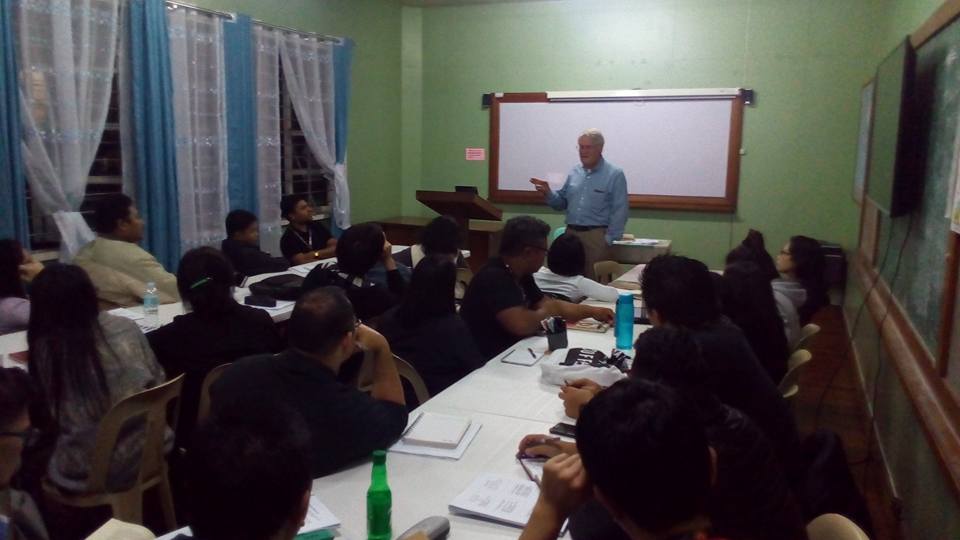
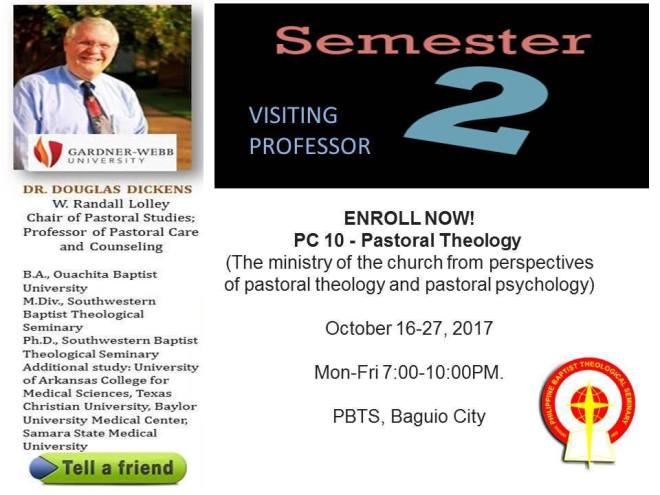
Course in Pastoral Theology being held at Philippine Baptist Theological Seminary, October 2017. It will be led by Dr. Doug Dickens, a Diplomate of CPSP.
https://bukallifecare.org/2017/09/17/pastoral-theology-course-in-october/
Course in Pastoral Theology being held at Philippine Baptist Theological Seminary, October 2017. It will be led by Dr. Doug Dickens, a Diplomate of CPSP.
https://bukallifecare.org/2017/09/17/pastoral-theology-course-in-october/
Presently (started July 17 and continuing to August 25), Dr. Cal Sodoy is holding half unit intensive CPE at Brokenshire Memorial Hospital in Davao City.
August 16, A unique extended program will be held at Mary Johnston Hospital in Tondo, Manila. It will be one day a week, for approximately a year. The goal is to work with full-time clergy, allowing them to train while being involved in their present ministries.
Last week in August. Bukal Life Care will start an extended half unit (over approximately 4 months). Trainees will meet 3 days monthly. The exact days will be determined based on the schedule of participants.
Additionally, Welcome Back to Chaplain Victor Layug from his year of residency in Atlanta, Georgia. As of August 1st, Chaplain Victor will return to his duties as chaplain at Mary Johnston.
We are happy to know that negotiations between CPSP and Union Theological Seminary in Cavite, Philippines have been successful. They are partnering to provide a Doctor of Ministry Degree in Clinical Pastoral Supervision.
This D.Min. requires satisfactory completion of a two-week residency at UTS, in the Philippines, and five three-hour courses completed online. Each of these courses will meet for thirty hours, usually extended over ten weeks, three hours a week.
The required residency is scheduled for January 8–19, 2018. The deadline for registration for the January 2018 seminars will be September 15, 2017. It is arguably less costly to fly from most U.S. cities to the Philippines and gather for two weeks at the UTS conference center than to fly across the U.S. and meet at a similar venue.
This particular program is designed for persons certified as clinical pastoral supervisors by recognized training organizations, persons such as diplomates in pastoral supervision in CPSP, educators (CPE supervisors) in ACPE, or those with equivalent credentials in other organizations. The program is also open to current clinical pastoral supervisors-in-training. For those still in training, the D.Min. degree will be awarded when both the supervisory credential is granted and the course work is successfully completed. The degree program may be done simultaneously with supervisory clinical training.
More information to come as it is promulgated by CPSP.
Article by Dr. Simplicio Dang-Awan Jr., Diplomate CPSP-Philippines
There are many people who may be unreal
or inauthentic. One way to understand the word is to talk about inconsistencies in one’s life-way. When one smiles on the outside but angry on the inside– one is not authentic. One who says he is a Christian, but his actions insult Christ whom he claims as his Lord, or one who says I ‘m humble and modest, but shows pride and arrogance to others is indeed not authentic.
Authenticity is one goal of Clinical Pastoral Education (CPE), because one is to subject himself/herself to self-awareness. This is like seeing your face through the mirror. Your group members will help you understand why you talk or behave the way you do with their feedbacks. This is called processing in CPE. We need to process ourselves as to
Has crying became our coping mechanism or not? There is a cause for every issue that we grapple with in life. We need someone who can mirror to us our behavior.
Example: Why are we angry with some elders who are of the same age as our father. This was the behavior of Pablo. His CPE Supervisor asked him to recall where that anger started out. The Supervisor suspected transference. Pablo then told a story about his dad, who enjoyed ridiculing him for urinating on his bed when he was 12 years old. He could not fight his father, of course, when he was young. When he became a person with authority, he shouts at elderly for little or no reason. He is transferring his hatred for his father to another person who is as old as his father then regrets after hurting the elderly. There was transference indeed as suspected. So Supervisors, and Pastoral Counselors in general, should be suspicious.
Another example is a Pastor who was delivering a sermon in a Church, when suddenly he saw a member texting while others are listening to him. He then burst into anger and castigated the person who was texting. He regretted showing his temper before his congregation. When he went into CPE he was encouraged by his Supervisor to look back into his upbringing, if there was any incident that may have triggered his anger. Then he recalled, “When I was in grade 6, I was scolded by my Teacher when I was reading a note passed by my classmate about a girl I like very much. Then he stopped lecturing and singled me out as one who does not listen to him when he is teaching us. I was so embarrassed in front of my classmates– especially the girl who laughed with the others at me.” That boy hated his teacher and when he became a Pastor he did the same to someone in his congregation. Why? Yes because that anger was not processed. In 2 Cor 5:17 says, “He who is in Christ is a new being, the old was gone and the new has come.” This is easier said than done. Unless the old and dirty behavior is processed and identified and thrown in the garbage, the old behavior may come back sooner or later.
Alfred Adler, a leading psychologist of the early 20th century, determined that there were three Universal Life Tasks They are described as universal in that they are not characteristic of humanity, rather than limited by gender, nationality, age, culture, or any other subset of humanity.

Alfred Adler (1870-1937)
They are:
Social Task (developing friendships)
Intimacy Tasks (developing sexual, as well as loving and familial, relationships)
Occupational Tasks (contributing positively to community)
Adler felt that “all the questions of life can be subordinated to the three major problems–the problems of comml life, of work, and of love.”
A failure in any of these three areas can (will?) lead to serious psycho-emotional problems.
Harold Mosak and Rudolf Dreikurs of the Alfred Adler Institute of Chicago, in 1966 suggested two more Universal Life Tasks. In so doing, they were actually taking some thoughts of Adler that had not been fully developed, and added to that some ideas from Lewis Way and Irvin Neufeld. They suggested that these other two– “all interrelated, and therefore, affecting the solution of the three tasks, but transcending them.”
Mosak and Dreikurs did not describe the last task in exactly those terms… no direct reference to God, for example. However, the idea is there. They described this task as “the need to adjust to the problems beyond the mere existence on this earth and to find meaning to our lives, to realize the significance of human existence through transcendental and spiritual involvement.”
These five universal tasks tie nicely with one of the most well known formulas in the Bible– ‘The Great Commandment.”
Love the Lord your God with all your heart, with all your soul, with all your strength, and with all your mind; and your neighbor as yourself. (Luke 10:27, HCSB)
If one looks at the first three universal life tasks, healthy intimacy with others, productive role in the community, and friendships with those around, these are all “neighbor or community” tasks. As such they could arguably be seen as aspects of “Loving one’s Neighbor.” Loving one’s neighbor can be seen, although not necessarily limited to having intimate relationships with family, positive friendships with those one interacts with regularly, and positive role in the broader community.
The fourth task (self-acceptance and self-respect) certainly relates to Loving Self, a love implied in the Great Commandment.
The fifth task (Spiritual Task) can be seen as relating to loving God.
So one could break down the Great Commandment into three components
Such an interconnection is not, perhaps, that interesting. What, arguably, is more interesting is the statement of Mosak and Dreikurs that the latter two tasks could be thought of as inter-related with the other three, but also transcending them.
Many theologians see the Great Commandment in a similar light. First, they see the Commandment, although consisting of two or perhaps three components, act as a unity. It is a single commandment with three inter-related parts. Second, however, two of the components transcend in a sense the third. That is, we are unable to love our neighbor unless we love God and we love ourselves. A failure of one component ultimately leads to a failure in all aspects.
If you are interested in reading the paper referenced of Mosak and Dreikurs, it is available HERE.
While we often focus on activities that are directly linked to CPSP-Philippines or CPSP, we do wish to acknowledge and promote activities from other organizations that share the same vision. With that.
#1. July 21-23. We are pleased to inform you that the Vanderpol Center for Leadership & Pastoral Formation will host its 4th Regional Asia-Oceania Consultation Seminar and Retreat on July 21-23, 2017 at the Winaca Eco-Cultural Village, Acop, Tublay, Benguet (http://www.winaca.com). The theme for this year’s retreat is “Deepening Spirituality: A Journey towards an Integrated Self.” We at Vanderpol Center understand and believe the value of having an integrated spirituality because we can only fully appreciate our value as human beings if we are truly integrated within ourselves, with our fellowmen, with our Creator, and with nature.
In this connection, we are inviting you to join us as we explore, reflect on and consult with fellow practitioners on the true meaning of spirituality, spirituality vs. emotional health, finding healing from trauma, etc. through the messages to be given by our speakers, reflections, seminars and small group consultation process. The seminar fee is PHP 4,500 (USD 90), which includes transportation to and from the venue, food, accommodation and materials. Please take note that in order to reserve a slot, there is a non-refundable pre-registration fee of PHP 1,000 (USD 20), which is due on July 7, 2017. The slots are limited to 40 participants only and the online registration will close on July 14, 2017. You may send us an email to secretariat@vanderpolcenter.org.
#2. September 19-22. We would like to invite you to The 11th Asia Pacific Congress-Convention on Pastoral Care and Counseling / APCPCC 2017) that will be held on Tuesday-Friday, 19-22 September 2017 in The Mercure Ancol, Hotel and Convention Centre, Ancol Baycity, Jakarta Utara, Indonesia. The APCPCC 2017 will designate the theme of ”PASTORAL MINISTRY AND VIOLENCE”.
#3. October. Dr. Doug Dickens will be back with us in Baguio City, and we at CPSP-Philippines are hoping to have another seminar with him. The topic is still up in the air, but the hope is to align it with International Pastoral Care Week (the last week in October).
Made changes to our “Supervisors/SITs page.
To be a CPO facilitator, the individual must have completed at least two full units of CPE, with recent experience in the supervisory process, and recommended by his or her supervisor.
Congratulations to all added to this page.
Clinical Pastoral Orientation (CPO) is a program designed for laypersons or ministers who don’t have time for CPE. It can also be done to get a taste for CPE. Additionally, it is set up to work more comfortably into a the normal (semester or quarter) schedule of a bible school or seminary.
In January, the BOT of CPSP-Philippines agreed to add CPO to the certification and accreditation standards. While this is still in progress, the following document provides some insight into the standards being proposed.
CPO is presently being done at Zamboanga Peninsula Medical Center, and Bukal Life Care in Baguio City will have one starting on June 19.
Click here to view the Rough Draft of the Standards: CPO Program
June 5-July 7. Brent Hospital. Zamboanga City. CPE Intensive. Supervisor Cal Sodoy.
June 19. Start of Clinical Pastoral Orientation at PBTS in Baguio City. Duration 15 weeks, meeting on Mondays. (Another CPO group is presently underway in Zamboanga at the Zamboanga Peninsula Medical Center, led by Chaplain Buac.)
Mid-August. Mary Johnston Hospital. Tondo, Manila. CPE Extended. Supervisor/SIT: Dr. Sim Dang-Awan Jr., and Chaplain Victor Layug.
Mid-August. Bukal Life Care. Baguio City. CPE Extended. Supervisor: TBD.
July 17-August 25. Brokeshire Memorial Hospital. Davao City. CPE Intensive. Supervisor Cal Sodoy.
September 19-22. Jakarta Indonesia. 2017 Asia Pacific Pastoral Care and Counseling Convention. http://2017apac-pcc-con.org/
October 9-November 17. Capiz Emmanuel Hospital. Roxas City. CPE Intensive. Supervisor Cal Sodoy.
April 24-25, 2017, we held a great conference on the grounds of Philippine Baptist Theological Seminary (PBTS). The conference was a partnership between CPSP-Philippines, CPSP, PBTS, and Bukal Life Care. This was the “2nd Dayot and Dickens Pastoral Care Conference.”
The main speaker is Dr. Doug Dickens, a CPSP-certified Diplomate Supervisor of Clinical Pastoral Education/Training. He has mentoring relationship with CPSP-Philippines. The topic was “The Beatitudes: Diagnosis and Healing from the Inside Out.” The topic looks at the Beatitudes as a form of pastoral diagnosis… not in terms of pathology, but in terms of holistic wellness. With 220 participants, we had a wonderful time, and look forward more gatherings like this in the future.

Dr. Dickens with CPSP-Philippines SITs, John Mark Bagalan and Violeta Canoy

Group Picture of the participants at PBTS Amphitheater